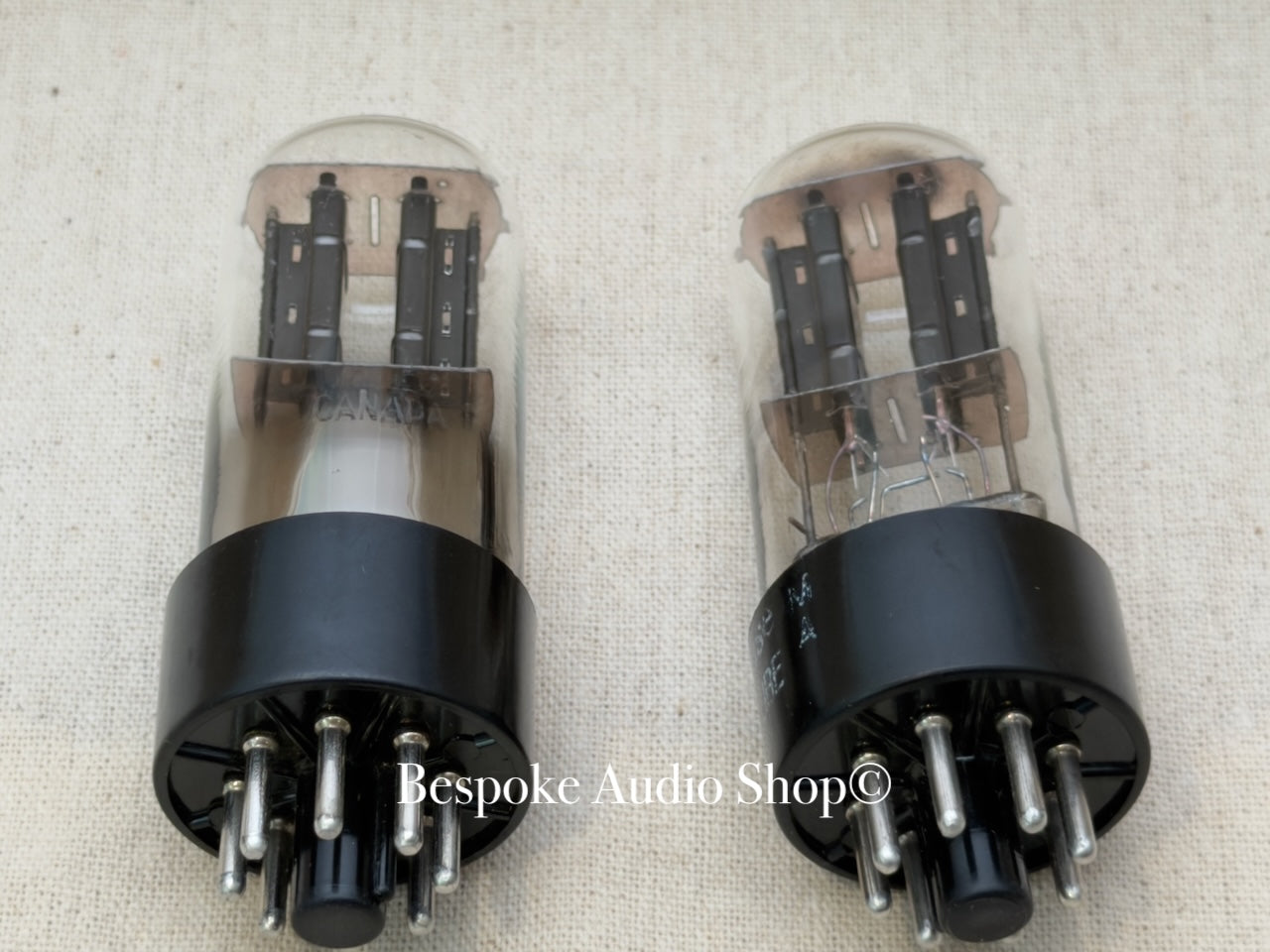
6SN7 Pair - Westinghouse - Made in Canada
6SN7 Pair - Westinghouse - Made in Canada
Couldn't load pickup availability
YOU WILL RECEIVE THE EXACT PAIR PICTURED. CHOOSE QTY 1 TO RECEIVE THIS EXACT PAIR.
Test Results on Jackson 648P:
104%
105%
These were not US-made Westinghouse tubes—they were produced at Westinghouse Canada, primarily in Hamilton, Ontario, roughly late 1940s through early 1950s.
Why Canadian Westinghouse matters
This is the key thing people miss:
Westinghouse Canada was not a dumping ground or a second-tier operation. It was set up to:
- Supply Commonwealth markets
- Reduce US export costs
- Build to long-life industrial and broadcast standards
As a result, many Canadian Westinghouse tubes are:
- Mechanically quieter
- Consistently built
- Less “hot-rodded” than some US versions
They’re closer in philosophy to RCA commercial or early GE industrial tubes than to flashy collector items.
Internal construction notes:
- Parallel medium-gray plates (not short plates, not staggered)
- Clean, symmetrical grid winding
- Solid mica support (no loose top getter flopping)
- Healthy getter flash (no signs of air or exhaustion)
This is a very stable 6SN7 build
Sonic character (what they sound like)
Canadian Westinghouse 6SN7s tend to be:
- Neutral to slightly warm
- Smooth through the midband
- Excellent tonal density
- Not etched or aggressive up top
- Strong low-level resolution
They don’t do the “romantic bloom” of early RCA VT-231, and they don’t have the sparkle of some Sylvania bad boys—but they’re honest, musical, and fatigue-free.
Think:
“Set it and forget it.”
How they compare in the 6SN7 universe
Very roughly:
- RCA VT-231 → lush, vintage, big midrange
- Sylvania early GT → open, airy, fast
- Westinghouse Canada (this tube) → balanced, controlled, natural
- Later 1950s GTBs → tougher, less refined
These sit in a sweet practical middle ground.
Not a trophy tube—but absolutely a working-class hero of the 6SN7 world.
These are solid tubes.
Share